
I Saw Amani in the Operating Theatre
What four women doctors taught me about girls' education, representation and the power of one story.
Girls' education expands opportunity, agency and economic participation. But before a girl can build a future, she often needs permission to imagine one. In an operating theatre in Pretoria, I was reminded that a book can help begin that journey.
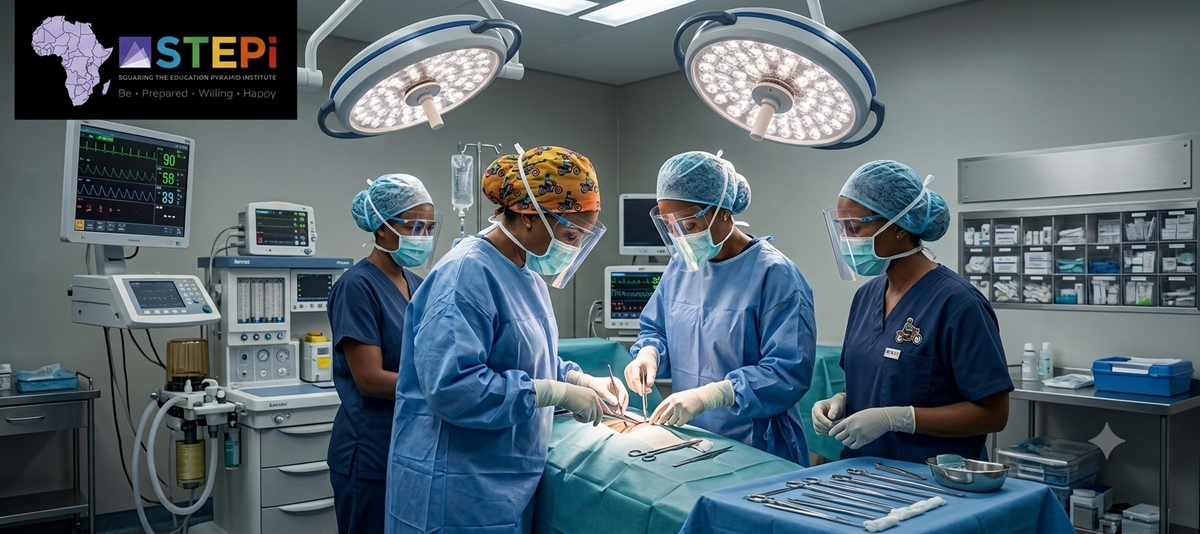
The operating theatre at Steve Biko Academic Hospital was alive with movement. Trays shifted, machines hummed and four specialist doctors prepared my daughter for surgery. Dressed in surgical clothing, I sat in the middle of it all, trying to take in every detail. It felt like a film montage, except there was no background music and this was my child.
Then I looked at my daughter, and the room seemed to pause.
I realised that I was the only man in the theatre. The four doctors about to operate on my daughter were all women.
I looked at them one by one and wondered: What is your story? When did you first imagine yourself here? Who encouraged you to become a doctor? And who, along the way, may have told you that this dream was not for you?
That was when I saw Amani.
The moment Amani entered the room
Amani is the determined young girl at the centre of STEPi's Amani the Boda-Boda Rider, written by Paul H. Sutherland and illustrated by Bahizi Jovan. She dreams of becoming a boda-boda rider — a motorcycle taxi rider — even though the people around her see it as work for boys and men. She is discouraged, but she keeps asking questions, keeps learning and keeps practising. With the support of her grandparents, she develops the skills, patience, discipline and courage to pursue her goal. [1]
The point of Amani's story is not that every girl should become a boda-boda rider. It is that no girl's future should be decided by a stereotype.
I do not know the personal stories of the four doctors who cared for my daughter, and I cannot assume that their journeys were the same as Amani's. What I do know is that becoming a specialist doctor requires years of education, training, sacrifice and persistence. Somewhere in each doctor's life, a dream had to be protected long enough for it to become a profession.
Perhaps that protection began with a teacher who took her seriously. Perhaps it came from a parent who made room for her questions, a woman whose example widened her view of what was possible, or a book that allowed her to picture herself in a future she had not yet seen.
Why girls' education is women's empowerment in action
Education is not only about passing examinations or collecting certificates. At its best, education gives a girl literacy, knowledge, confidence, practical skills and a stronger voice in the decisions that shape her life. It expands the range of choices available to her.
The relationship between education and women's empowerment is supported by a substantial body of evidence. A World Bank review covering 1,120 estimates in 139 countries found that the average private return to an additional year of schooling was about 9 per cent, while the return for women was about two percentage points higher than for men. This does not mean that women earn more than men overall. It means that education is an especially valuable investment in women's economic opportunity. [2]
The wider social effects are just as important. World Bank research associates higher educational attainment for girls with greater earning potential, later marriage and childbearing, improved health and nutrition, and stronger decision-making agency. The same research estimated that barriers preventing girls from completing 12 years of education cost countries between US$15 trillion and US$30 trillion in lost lifetime productivity and earnings. [3]
Experimental evidence shows what can happen when practical barriers are removed. In a large randomised study in Niger, a scholarship programme designed to support girls' secondary education halved both school dropout and marriage rates after three years, while also raising the aspirations of girls and their parents. [4]
Education, however, is not a magic trick. Schooling alone cannot erase discrimination, unsafe environments, poverty or restrictive social expectations. Empowerment also needs quality teaching, safety, supportive adults, access to health services and realistic routes into further study and decent work. Education is a foundation, but people and systems must help a girl build on it.
Why one story still matters
Before a child can read to learn, she needs the opportunity to fall in love with books. Shared reading is one practical place to begin. A 2020 meta-analysis of 19 randomised trials involving 2,594 children aged one to six found that book-sharing interventions improved children's expressive and receptive language and substantially strengthened caregivers' book-sharing skills. [5]
Stories also help children test ideas about identity and possibility. A review of research on counter-stereotypical role models found that seeing women and girls in non-traditional roles can reduce gender stereotypes. The evidence also offers an important caution: a brief encounter with one role model does not automatically change a child's future. Repetition, discussion, relatability and support from families, teachers and communities all matter. [6]
That is why Amani is useful. She is not a slogan and the book is not a promise of instant transformation. She is a conversation starter. Her story gives an adult a natural way to ask a child: What do you want to become? What might stand in your way? What will you need to learn? Who can help you? What can you practise today?
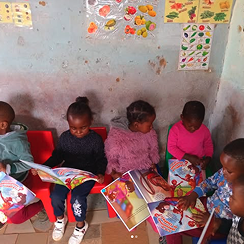
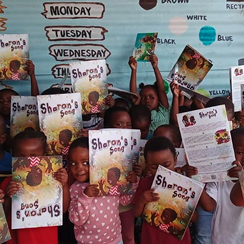
This is central to STEPi's work. We want children in under-resourced communities to experience books as sources of joy, connection and possibility. When children enjoy stories, they are more willing to return to books. With consistent support, that enjoyment can grow into the literacy and confidence they need to read, learn and participate more fully in the world.
How to turn Amani's story into practical encouragement
Ask before you advise.
After reading, ask the child what she noticed, how Amani felt and what she would have done. Listen without correcting her dream.
Name the strengths behind the success.
Help her identify Amani's courage, patience, persistence, self-discipline, curiosity and willingness to learn. Then ask where she already shows those strengths.
Connect the dream to learning.
Ask, 'What would someone in that role need to know?' Turn a distant ambition into a small next step, such as reading about the career, practising a skill or speaking to someone who does the work.
Build a circle of encouragement.
One supportive adult matters; several supportive adults can change the environment around a child. Invite parents, teachers, older learners and community members into the conversation.
Include boys.
Girls should not carry the work of changing gender expectations alone. Boys also need stories and conversations that teach respect, equality and shared responsibility.
The women I saw
When I returned from that moment of reflection and walked out of the operating theatre, I looked again at the four doctors. I did not see symbols. I saw skilled professionals holding my daughter's wellbeing in their hands.
But I also saw what can become possible when a girl's ability is nurtured rather than narrowed.
Every one of those doctors had once been a child. Before the qualifications, the long hours and the responsibility, there was a beginning. There was a first question, a first lesson and perhaps a first person who said, 'Yes, you can.'
I saw Amani because Amani represents that beginning.
There is no single book, classroom or conversation that can remove every barrier. There is no magic trick. There is, however, the steady work of placing good stories in children's hands, helping them learn, surrounding them with encouragement and refusing to let circumstance or stereotype write the ending for them.
A call to women: buy a book, help a girl dream
To every woman who has ever been encouraged by another woman — and every woman who wishes someone had encouraged her sooner - this is your invitation.
Buy a copy of Amani the Boda-Boda Rider. Read it with a daughter, niece, learner or neighbour. Give it as a gift. Use it to ask a girl what she dreams of becoming, then take her answer seriously.
Every STEPi book sale contributes to STEPi's literacy and educational work in under-resourced communities. Your purchase helps us create more opportunities for girls to encounter stories, conversations and learning experiences that say: [7]
'Your dream matters. You can learn. You can prepare. You can choose. Your future is not limited by where you began.'
Buy Amani. Help a girl dream.
Research sources and further reading
[1] STEPi. Amani the Boda-Boda Rider — Successful African Child Story.
[2] Psacharopoulos, G., and Patrinos, H. A. (2018). Returns to Investment in Education: A Decennial Review of the Global Literature. World Bank Policy Research Working Paper 8402.
[3] Montenegro, C. E., Wodon, Q., Nguyen, H., and Onagoruwa, A. (2018). Missed Opportunities: The High Cost of Not Educating Girls. World Bank.
[4] Giacobino, H., Huillery, E., Michel, B., and Sage, M. (2024). Schoolgirls, Not Brides: Education as a Shield against Child Marriage. American Economic Journal: Applied Economics, 16(4), 109-143.
[5] Dowdall, N., Melendez-Torres, G. J., Murray, L., Gardner, F., Hartford, L., and Cooper, P. J. (2020). Shared Picture Book Reading Interventions for Child Language Development: A Systematic Review and Meta-Analysis. Child Development, 91(2), e383-e399.
[6] Olsson, M., and Martiny, S. E. (2018). Does Exposure to Counterstereotypical Role Models Influence Girls' and Women's Gender Stereotypes and Career Choices? Frontiers in Psychology, 9, 2264.
[7] STEPi. Official website. STEPi states that book sales contribute to its literacy and educational work in under-resourced communities.